

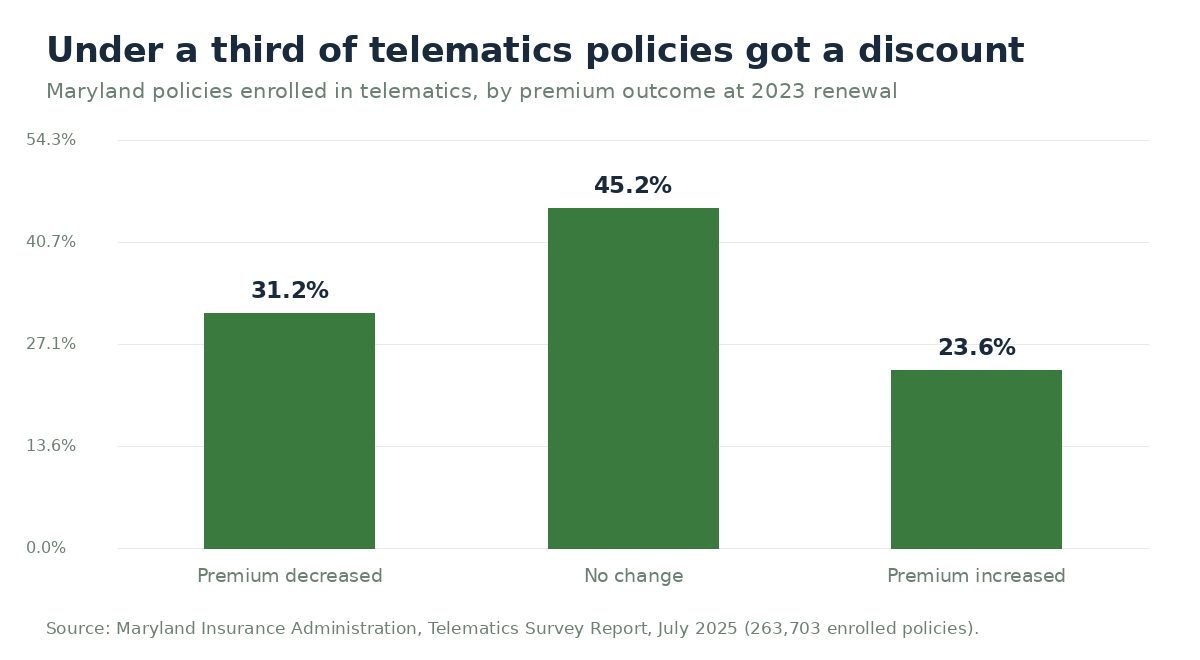
Usage-based insurance is the industry’s favorite answer to the premium spikes of the last few years: install our app, drive well, save up to 40%. The fine print is a different document. The Maryland Insurance Administration surveyed the insurers writing 80.9% of that state’s auto market and pulled the renewal outcomes for every policy enrolled in a telematics program. In 2023, 31.16% of enrolled policies saw a premium decrease, 23.6% saw an increase, and roughly 45.24% saw no change. I spent years on the marketing side of insurance, including the funnels that sell these programs, so here is what the enrollment screen leaves out. Telematics means the insurer watches how you drive and prices you on it. For some drivers that is good news. For others it becomes evidence for a higher rate.
What the app actually records
Through a phone app, a plug-in device, or your car’s built-in connectivity, most programs score some mix of: mileage, braking hardness, acceleration, speed, cornering, time of day you drive, and whether you handle your phone while moving. After a monitoring period, typically 30 days to 6 months, the score becomes a discount, nothing, or with some carriers, a surcharge. That last possibility matters more than anything else here, so it gets its own section.
The only program feature that really matters
Programs come in two kinds: discount-only, where the worst case is saving nothing, and adjustable, where bad scores raise your rate. As of 2026 reporting by the Consumer Federation of America and program comparisons, carriers including State Farm, USAA, Nationwide, American Family, and Farmers advertise discount-only designs, while programs from Progressive, GEICO, Allstate, and Travelers can raise rates for risky-looking data. Terms change and vary by state, so verify your carrier’s current language before enrolling, but the sorting question never changes: can this program make my insurance more expensive? If the answer is yes and you are not certain you are a low-mileage, daytime, smooth-pedal driver, you are volunteering to have your rate raised.
| Question to ask | Good answer | Walk-away answer |
|---|---|---|
| Can my rate go up from this data? | No, discount-only, in writing | Yes, or vague language about “personalized rates” |
| What is the realistic discount? | A number tied to my profile, not the ceiling from the ad | “Up to 40%” with no median disclosed |
| Who else gets my driving data? | Named uses, no third-party sale | Broad sharing language, data brokers unnamed |
| What happens if I quit mid-program? | Discount ends, nothing else | Collected data still rates my renewal |
Who actually wins
The profile that collects real money is specific: under roughly 7,000 miles a year, driving mostly in daylight, no hard braking habits, phone in a mount and untouched. Carrier program disclosures generally put the low-mileage advantage around that range. Households with a driver under 25 tend to have the most to gain, because young drivers carry the highest default pricing in the book and a clean monitored record is one of the few things that moves it. Remote workers, retirees, and second-car households fit the winning profile almost by definition. For true low-mileage drivers, pay-per-mile products, which price on mileage alone rather than behavior scoring, can beat behavior-scored programs entirely.
Who quietly pays more
Night-shift workers get scored as risky for their commute hour regardless of how carefully they drive it, because crash data makes midnight to 5 a.m. expensive for the pool. City drivers rack up hard-braking events that are really just traffic. High-mileage drivers start the scoring in a hole. And anyone with a lead foot on on-ramps is generating exactly the acceleration events the model prices. In an adjustable program, some of those drivers end up paying for everyone else’s discount. The design works as intended. My complaint is with ads that sell the best case and bury the typical result in a footnote.
The privacy trade is the actual price
You pay for the discount with data more than with driving skill. A handful of states regulate telematics data practices tightly, and your state insurance department can tell you whether yours is one. Elsewhere, your carrier’s privacy policy governs what happens to your trip history, and some policies permit sharing with third parties. This stopped being theoretical in March 2026, when Reuters reported a federal judge allowed a privacy lawsuit against Allstate to proceed over allegations involving phone-derived driving data; the company disputes the claims, and the case is unresolved, but it tells you regulators and courts are now reading the same fine print you should. California, notably, restricts telematics-based pricing so heavily the programs are effectively unavailable there.
The pay-per-mile math, worked
Pay-per-mile gets its own worked example because it is the one version of usage-based pricing where you can check the math before enrolling. These programs charge a monthly base rate plus a per-mile fee. Illustrative numbers: a $34 monthly base plus 8 cents per mile, driven 6,000 miles a year, totals $888. The same driver quoted $1,400 on a conventional policy saves about $512, no behavior scoring involved. Run the same program at 14,000 miles and the total hits $1,528, now more expensive than the flat policy. In this example the break-even point is about 12,400 miles a year, which is why these products suit the second car, the retiree and the remote worker, and usually not the daily commuter. Your quote will differ. The point is that nothing here scores your braking, only your odometer, and you can work out your own break-even in a minute.
What a bad score is actually made of
The scoring models are proprietary, but the disclosed factors are consistent across programs, and knowing them explains most surprising scores. Hard braking is logged when deceleration crosses a set threshold, which city traffic triggers constantly through no fault of yours. Phone handling counts motion of the device while the car moves, which is why a phone loose in a cupholder can score against you while a mounted phone does not. Night driving between roughly midnight and 5 a.m. is weighted heavily because that window carries disproportionate crash severity in the pool data. And mileage compounds everything, since every additional mile is another opportunity to log an event. None of this measures whether you are a good driver. It measures whether your driving looks like the driving that files claims. That is a different question, and it explains how a careful night-shift nurse can score worse than a careless weekend driver.
Three questions before you enroll
- Do I actually fit the winning profile: low miles, daytime, smooth? If I have to talk myself into it, I am not.
- Is the program discount-only, in writing? If it can raise my rate, the downside is not zero, whatever the ad says.
- Is the realistic prize worth the data? Weigh the realistic odds, roughly one enrolled policy in three seeing a decrease in the Maryland data, against a permanent log of everywhere you drive.
How to quit cleanly if you change your mind
You can leave, but some exits are cleaner than others. Before you join, get the exit terms in writing: in some programs, unenrolling simply ends the discount, while in others the data already collected still rates your next renewal, which means a bad monitoring month can follow you out the door. If you are already enrolled and unhappy, time your exit before the renewal rating date, and ask directly whether collected data will be used in your renewal price. The clean reset that always works: switching carriers, since your telematics history does not transfer between companies. A new carrier prices you on the traditional factors, and depending on your score, that is either a loss or a relief.
Three things people ask
Can I just drive carefully during the monitoring period and then relax?
Some programs score a fixed window; others monitor continuously and re-rate at renewal. The fixed-window version rewards exactly the strategy you are describing, which is why carriers are moving away from it. Ask which type you are joining.
Is the enrollment discount free money?
The sign-up discount, often 5% to 10%, is real for the first term. It is also how they get you in. Your renewal is priced on the data, so take the enrollment discount only if you would enroll without it.
Should I try telematics before the cheaper fixes?
No. Shopping carriers and restructuring coverage move more money faster with zero data cost; start with the same-week checklist and the full rate-lowering guide. And if the goal is understanding why the bill jumped at all, that story is about the whole insurance pool, not you: here is what actually happened to your rate.
Program terms vary by carrier and state and change frequently. Verify current terms with the carrier before enrolling, and check your own state insurance department for the rules that apply where you live.

Sources
3
Every figure in this article traces to a government record or to a named independent, non-commercial research body. We do not cite insurance marketplaces or affiliate comparison sites for data.
- Maryland Insurance Administration Telematics Survey Report, Auto Insurance Market in Maryland Published 2025-07Supports: Survey of 18 insurers representing 80.9% of the Maryland auto market. Of 263,703 in-force policies enrolled in telematics in 2023, 62,233 (23.6%) saw a telematics-driven premium increase at renewal and 82,170 (31.16%) saw a decrease, leaving roughly 45.24% with no change. Enrollment rose from 9.49% of policies in 2021 to 13.23% in 2023. The Administration discloses that the no-change share is overstated because some 2023 enrollments did not renew until 2024
- Consumer Federation of America Insurance Companies Claim Telematics Will Save You Money on Auto Insurance. The Truth Is More ComplicatedSupports: Which carriers run discount-only versus surcharge-capable program designs. Consumer advocacy organization, not industry funded; its stated position is adversarial to insurers and readers should weigh it as advocacy rather than neutral measurement
- California Code of Regulations / California Department of Insurance 10 CCR 2632.5, auto rating factor regulations under Proposition 103Supports: California restricts the rating factors that may be used in personal auto, which is why behavior-scored telematics pricing is effectively unavailable there
Figures last verified August 29, 2026.