

In June 2025 the Consumer Financial Protection Bureau corrected a figure it had published a decade earlier and that most writing on this subject still repeats. Its 2015 estimate that 11.0 percent of American adults, 25.9 million people, had no credit record at all in December 2010 was revised down to 5.8 percent, or 13.5 million out of 235 million. The records existed. The Bureau’s earlier data source had excluded credit files containing only deferred student loans, collections, or closed accounts.
The correction changes the diagnosis. Applying a consistent method across years, the CFPB found the share of adults with a scored credit record rose from 81.6 percent in 2010 to 87.5 percent in 2020. Most people who cannot get approved for a card are already in the system. They hold a file a scoring model declines to score, which is a different problem with a different fix.
Three states, not two
The Bureau works with three conditions rather than a simple yes or no, and the route out differs for each.
- Credit invisible. No record at a nationwide consumer reporting agency. Nothing to score because nothing exists.
- Unscored, insufficient. A record exists but carries too little history for a scoring model to produce a number.
- Unscored, stale. A record exists with enough history, but no recent activity. The file has gone quiet.
The practical difference is large. A stale file often needs nothing more than activity reported on an account somebody already holds, which is the same lever covered in our guide to building a credit score from zero. An insufficient file needs one more tradeline that reports monthly. Only the first case requires building a record from nothing, and on the corrected numbers it is the smallest of the three groups.
Holding a card and being scoreable are also not the same condition. The CFPB’s 2025 report to Congress on the credit card market counted 3.5 million consumers with a thin or stale score file who held at least one credit card at the end of 2023, 2.5 million of them holding only general purpose cards and 0.9 million only private label cards. Over the same decade, cardholding among adults under 25 rose from about 26 percent in 2014 to 38 percent in 2024.
The four routes onto the file
A first credit card behaves more like a rental deposit than a loan. The lender is buying a record of somebody paying on time, on an amount small enough that being wrong about them is cheap. That framing explains why the four common routes look so different from one another and still do the same job.
| Route | How approval works | What it costs | Where it falls down |
|---|---|---|---|
| Secured card | A refundable deposit funds the limit, so the issuer carries almost no risk and history is not required. | Cash tied up for the life of the account, plus an annual fee on some products. | Not every product graduates to an unsecured line, and not every issuer returns the deposit promptly on closure. Ask both questions before applying. |
| Student card | Enrollment substitutes for history. Income rules under the CARD Act still apply to applicants under 21. | Usually no annual fee, with a low starting limit. | Availability ends with enrollment, and eligibility windows are narrow. |
| Retail or private label card | The loosest underwriting of the four, offered at the point of sale where the decision gets made in a hurry. | The highest pricing in the market. Average APR on private label cards reached 31.3 percent in 2024, the highest the CFPB has recorded since at least 2015, and more than 90 percent of retail cards reported a maximum APR above 30 percent. | It works as a tradeline and punishes any balance, and moving one later is its own exercise in balance transfer arithmetic. In 2024, 20 percent of private label cardholders made only the minimum payment, against 15 percent on general purpose cards. |
| Authorized user on an existing account | No application and no underwriting. The primary cardholder adds the user. | Nothing directly, but the primary account holder carries the liability. | Issuers differ on whether and how they report authorized users, and the account history transfers only if it is reported. Confirm with the issuer rather than assuming. |
A fifth route is opening up underneath these four. The CFPB reports that alternative data, particularly bank account cash flow information, is being used to extend card access to consumers with limited credit history. That underwriting looks at money moving through a checking account rather than at a score, which is why a thin file is less of a hard stop than it was ten years ago.
What the market charges a brand new account
The average APR on general purpose credit cards opened in 2024 was 27.5 percent, against 19.8 percent on accounts opened ten years earlier. Some of that is the Federal Reserve. Most people stop the analysis there, and it is the wrong place to stop.
A variable card rate has two components: the prime rate, which tracks the federal funds rate and is outside the issuer’s control, and the APR margin, which the issuer sets as a business decision. The margin is the part worth watching, because it does not move when the Fed moves. Across general purpose accounts tied to prime, the average margin reached 16.4 percent in 2024, more than 300 basis points higher than in 2015. On newly opened accounts alone it was 19.2 percent.
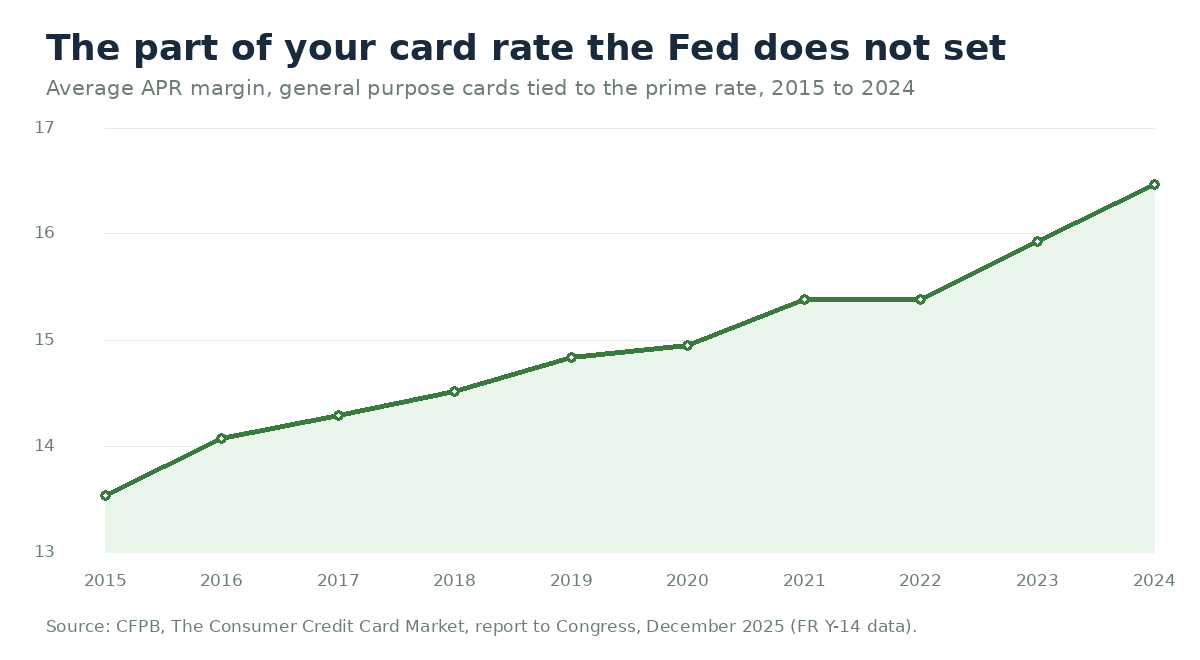
Two fee lines matter more than the rate on a small starting balance.
- Annual fees. Only about one general purpose account in six carried one during 2024, and starter products are largely outside that group. Below-prime cardholders used to pay these fees more often than anyone else between 2015 and 2021; the CFPB records that pattern reversing. Where a first card does charge a fee, read it as the price of approval rather than the price of any benefit.
- Late fees. This is where the cost actually lands on a small limit. Of every late fee charged across the market during 2024, two fifths came from the deep subprime tier, a group holding roughly a seventh of all card accounts. A brand new file starts life in the half of the market where the payment date, rather than the rate, is the expensive variable.
The arithmetic on a small limit
Round illustrative numbers chosen to show the mechanism, not market averages. Take a $500 limit with $50 carried from one month to the next at 27.5 percent. The interest is roughly $1.15 for the month. A single missed payment on the same account commonly triggers a fee many times that figure, and the CFPB’s late fee distribution above shows where those fees concentrate.
The payment date does more work than the interest rate on a balance this size. Comparing starter cards on APR alone is comparing them on the term that matters least.
The second number to run is utilization, which is the reported balance divided by the limit. On that $500 line, $50 reports as 10 percent and $250 reports as 50 percent. The reported figure is usually the statement balance, so a card paid in full after the statement closes can still report a high number. Paying before the statement date, not just before the due date, is what changes what gets reported.
What the file is worth once it exists
The reason to do any of this is priced, and the CFPB publishes the price. Its total cost of credit measure adds all interest and fees paid in a year and expresses them as a share of balances. On general purpose accounts that revolved a balance in 2024, that cost ran 36 percent for cardholders with deep subprime scores, 28 percent at near-prime, 23 percent at prime, and 13 percent at superprime.
Read the gap between the ends of that range rather than any single figure. A revolving cardholder at the bottom of the range paid close to three times as much per dollar borrowed as one at the top, on the same product in the same year. Nothing about the card changed. The file did.
The effective interest rate, which strips out fees and measures only interest actually charged on revolving general purpose balances, showed the same shape in 2024: 26 percent at deep subprime against 11 percent at superprime. Those figures apply to people carrying balances, so they describe what the file is worth to somebody who borrows rather than to somebody who pays in full every month. For a cardholder who never revolves, the score does its work elsewhere, on mortgage pricing, deposits, and approvals.
Four questions for the issuer, asked before you apply
Three of these are asked over the phone with the issuer before applying. The answers vary by product within the same bank, so a general reputation is not an answer.
- Does this account report to all three nationwide agencies, every month? A tradeline that reports to one agency builds one file. Scoring models read whichever file the lender pulls.
- Does it graduate, and on what timetable? For a secured product this decides whether the deposit comes back without closing the account and losing its age.
- What is the fee schedule, line by line? Annual fee, late fee, and any monthly maintenance or program fee. On a small limit these dominate the total cost.
- Is there a soft-pull prequalification? Applying blind to several products in a short window adds hard inquiries to a file that has little else in it.
The order of operations
Start by finding out which of the three states applies. Free reports from all three nationwide agencies are available at annualcreditreport.com, the site established under federal law, and a report that exists but returns no score is a different starting point from no report at all.
If the file is stale, the cheapest move is often reactivating something already on it rather than opening anything new. If the file is thin, one reporting account is enough to begin with; a second adds little and costs another inquiry. If there is no file, the secured route is the most predictable of the four because approval does not depend on history at all. If a lender has already declined an application, the separate question of borrowing with damaged credit is not the same problem as a thin file and does not have the same answer.
Then automate the payment for the full statement balance on the day after payday, keep the reported balance low against the limit, and leave the account open once it has served its purpose. Account age is one of the few inputs that cannot be bought back later.
Six months of on-time reporting on one small account typically does more to move a file from unscoreable to scoreable than the choice between the four routes above. The product matters less than most writing on this subject implies. The reporting behaviour is the whole exercise.
Frequently asked questions
What does credit invisible mean versus unscored?
Credit invisible means no record exists at a nationwide consumer reporting agency. Unscored means a record exists but a scoring model will not produce a number—either because the file is thin (insufficient history) or stale (no recent activity). The CFPB June 2025 credit invisibles technical correction treats those as different states with different first moves.
How many adults are truly credit invisible after the CFPB correction?
The Bureau revised the December 2010 estimate from 11.0 percent (25.9 million) down to 5.8 percent (13.5 million of 235 million adults). On a consistent method, the share of adults with a scored credit record rose from 81.6 percent in 2010 to 87.5 percent in 2020. Details are in the CFPB June 2025 credit invisibles technical correction.
What are the four common routes to a first credit card with no file?
Secured cards (refundable deposit funds the limit), student cards (enrollment substitutes for history), retail or private-label cards (often looser point-of-sale underwriting), and becoming an authorized user on someone else’s account. Cash-flow / alternative data is an emerging fifth path some issuers use. Walk the tradeoffs in first credit card with no credit file.
Why can a private-label card be a costly first tradeline?
It can work as a reporting account, but pricing is often the highest in the market. The CFPB 2025 Consumer Credit Card Market report put average private-label APR at 31.3 percent in 2024, with over 90 percent of retail cards reporting a maximum APR above 30 percent, and 20 percent of private-label cardholders making only the minimum payment versus 15 percent on general-purpose cards.
Does holding a card automatically mean I am scoreable?
No. The CFPB 2025 Consumer Credit Card Market report counted 3.5 million consumers with thin or stale score files who still held at least one credit card at year-end 2023. A tradeline helps only if it reports enough recent history for the model your lender uses.
On a small starter limit, what costs more—APR or a late fee?
On a small revolving balance, interest can be a few dollars while a single late fee is often many times that. The CFPB 2025 Consumer Credit Card Market report notes deep-subprime cardholders held roughly a seventh of accounts yet generated about two-fifths of late fees in 2024. Automate the full payment; treat the due date as the expensive variable.
What four questions should I ask the issuer before I apply?
Ask whether the account reports to all three nationwide agencies every month; whether a secured product graduates and on what timetable; the full fee schedule (annual, late, maintenance); and whether soft-pull prequalification is available so you are not stacking hard inquiries on a thin file.
How does utilization work on a $500 limit?
Utilization is reported balance divided by limit. On a $500 line, $50 is 10 percent and $250 is 50 percent. Many issuers report the statement balance, so paying after the statement closes can still leave a high reported figure. Paying before the statement date—not only before the due date—is what changes what gets reported.
If my file is stale rather than empty, do I still need a new card?
Often no. A stale file may only need recent reported activity on an account you already hold. An insufficient file usually needs one more monthly-reporting tradeline. Only a true invisible file requires building from nothing. Sequence that diagnosis in building credit from zero before you apply.
What is the order of operations for a first card?
Pull all three free reports at AnnualCreditReport.com, identify invisible vs thin vs stale, open one account that actually reports (or reactivate if stale), automate payment of the full statement balance, keep reported utilization low, and leave the account open so age compounds. Six months of clean reporting usually matter more than which of the four routes you chose.

Sources
2
Every figure in this article traces to a government record or to a named independent, non-commercial research body. We do not cite insurance marketplaces or affiliate comparison sites for data.
- Consumer Financial Protection Bureau The Consumer Credit Card Market: Report to Congress, 2025 Published 2025-12-30Supports: 3.5 million consumers with thin or stale score files held a card at year-end 2023 (2.5M general purpose only, 0.9M private label only); under-25 cardholding 26 percent in 2014 to 38 percent in 2024; average APR on new general purpose accounts 27.5 percent in 2024 against 19.8 percent ten years earlier; average APR margin 16.4 percent overall and 19.2 percent on new accounts in 2024, up over 300 basis points since 2015; private label average APR 31.3 percent in 2024 and over 90 percent of retail cards reporting a maximum APR above 30 percent; 20 percent of private label and 15 percent of general purpose cardholders made only the minimum payment in 2024; 16 percent of accounts carried an annual fee, average $127 in 2024 against $105 in 2022; deep subprime cardholders held about 14 percent of accounts and generated 40 percent of late fees while superprime and prime plus held 59 percent of accounts and paid 7.8 percent; total cost of credit on revolving general purpose accounts 36 percent deep subprime, 28 percent near-prime, 23 percent prime, 13 percent superprime; effective interest rate 26 percent deep subprime against 11 percent superprime; alternative and cash flow data expanding access for consumers with limited credit history.
- Consumer Financial Protection Bureau Technical correction and update to the CFPB credit invisibles estimate Published 2025-06-23Supports: Share of adults credit invisible in December 2010 revised from 11.0 percent (25.9 million) to 5.8 percent (13.5 million) of 235 million; share of adults with a scored credit record rose from 81.6 percent in 2010 to 87.5 percent in 2020 on a consistent method; the original panel excluded records containing only deferred student loans, collections or closed accounts.
Figures last verified August 29, 2026.