

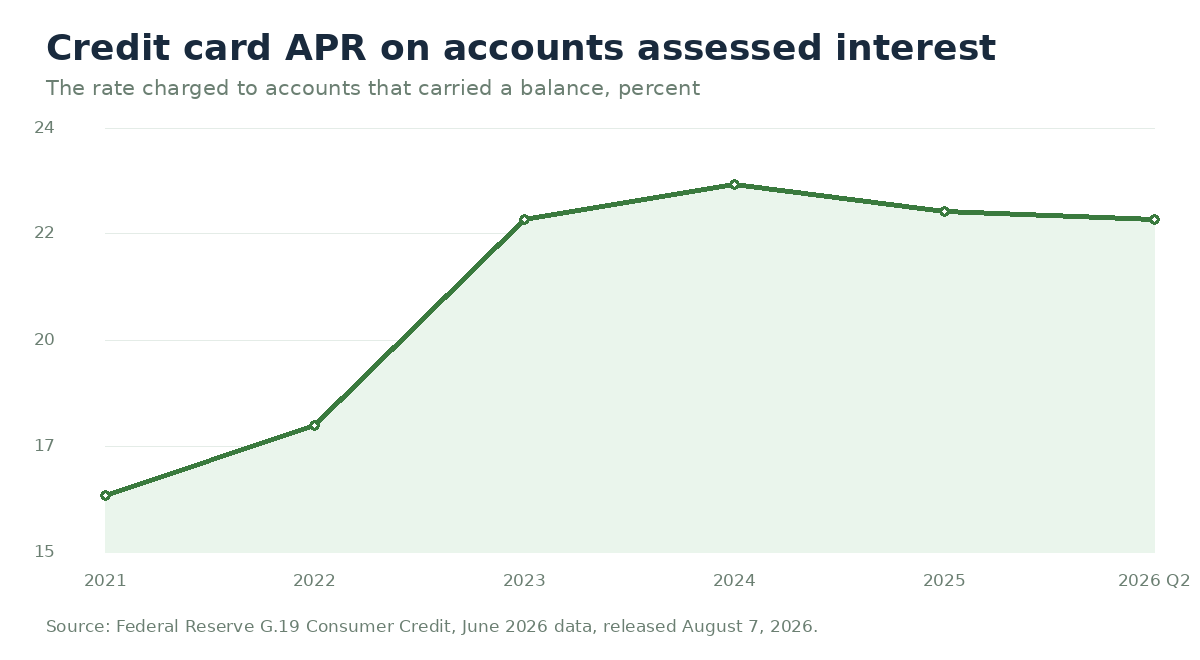
The average rate on credit card accounts assessed interest was 22.15 percent in the second quarter of 2026, according to the Federal Reserve’s G.19 consumer credit release published August 7, 2026. Across all accounts, including those paid in full every month, the average was 20.94 percent. The 24-month personal loan average at commercial banks in the same quarter was 11.86 percent.
Those three figures are the entire argument for paying attention to sequence. Money costs different amounts depending on where it sits, so the order in which balances get retired decides how much you rent along the way.
Here is that math, run on a fixed monthly budget, with every result shown. The order that wins is the one most guides recommend. It wins by less than they imply, and the size of the margin changes what you should do with it.
What a minimum payment is engineered to do
The CFPB’s 2025 Consumer Credit Card Market Report, released December 30, 2025, found that the share of cardholders making only the minimum payment is at its highest level since at least 2015. The same report put total interest assessed on cardholders at $160 billion in 2024, up from $105 billion in 2022.
A minimum payment is the smallest amount that keeps an account current, which is a different job from paying the balance off. On most cards it is calculated as roughly one percent of the balance plus that month’s interest and fees, with a floor of about $25.
Run that formula on an $8,000 balance at 22.15 percent. Paying only the minimum retires it in about 277 months, roughly 23 years, and costs about $13,696 in interest. Adding a flat $100 a month on top brings it to 58 months and about $3,968. I picked $8,000 as a round number for illustration, not as a market average, and the minimum-payment formula is the common one described above rather than any specific issuer’s terms.
Notice what the structure does. Because the minimum floats down with the balance, the amount applied to principal shrinks every month, which stretches the tail of the loan out for years. Any fixed amount added on top does not shrink, so it does progressively more of the work as the balance falls.
Rank by rate, which is what the law already does inside one card
Two balances at different rates are two taxi meters. Both are running. Only one of them is running fast, and the passenger decides which one to stop.
Federal law already applies that logic within a single account. Under Regulation Z, 12 CFR 1026.53(a), when a cardholder pays more than the required minimum, the issuer must allocate the excess first to the balance carrying the highest annual percentage rate, then to the remaining balances in descending order of rate. A card holding a purchase balance at 24 percent and a promotional balance at zero receives the extra money against the 24 percent first.
That protection stops at the edge of the account. Nothing allocates across separate cards or lenders. Sequencing several balances is the cardholder’s job, and it is the same rule the regulation applies: highest rate first.
The competing method reverses it and targets the smallest balance first, on the argument that clearing an account quickly is what keeps a person paying. Price both approaches instead of arguing about them.
The two orders, priced
Take two balances totaling $10,000: $8,000 at 22.15 percent and $2,000 at 12 percent. The budget is $400 a month, held constant. Minimums are paid on everything, and every dollar above the minimums goes to one target until it clears. These are round illustrative numbers chosen to show the mechanism, not market averages.
| Method | Highest rate first | Smallest balance first |
|---|---|---|
| Months to clear both | 33 | 34 |
| Total interest paid | $2,898 | $3,388 |
| First balance gone in month | 29 | 9 |
Calculated on the terms above, interest compounded monthly. Reproduce it with any amortization calculator.
Highest rate first wins by $490 and one month. Over 33 months that is about $15 a month, which is a real saving and a smaller one than the usual framing suggests. The rate-ordered method is correct, and the gap it produces on two ordinary balances is modest.
The other column has a number in it too. The smallest-balance method clears an entire account in month nine, where the rate-ordered method clears nothing until month 29. For someone who has abandoned two previous attempts, twenty months of visible progress may be the variable that decides whether the plan survives at all. Paying $490 for that is a defensible trade if you make it on purpose.
The gap widens when the rate spread widens. Two balances at 25 percent and 6 percent produce a much larger difference than 22 percent and 12 percent. Before choosing, put your own rates and balances into the same calculation, because the answer is specific to the spread.
Where a cash buffer fits in the sequence
What stalls most plans is a different question: whether to hold any cash back at all while a balance is outstanding at 22 percent.
On pure arithmetic there is no contest. A dollar applied to a balance charging 22.15 percent avoids 22.15 percent, and no insured deposit account pays anything close to that. Judged one dollar at a time, every dollar belongs on the balance.
The arithmetic changes once you account for what happens next. A household with no cash and a paid-down card meets its next transmission failure with that same card, at that same rate, having spent the intervening months paying it down. The buffer earns its place by stopping the debt from being re-created, which is a different job from competing with it on yield.
The practical version most operators land on is a small fixed buffer first, then the rate ladder. Small means enough to cover an ordinary emergency, not a catastrophe. A household that builds $1,000 before attacking the balance loses a few months of progress. A household that builds six months of expenses first will typically spend years paying 22 percent for the privilege.
The limit that does not go away
Paying a card to zero does not remove the line. The CFPB’s 2025 report put the total credit line across all consumer credit cards at over $5.7 trillion at the end of 2024, against roughly $1.2 trillion in credit card debt outstanding. Most of the borrowing capacity in the system is unused, sitting on accounts that are current.
That is the structural reason repayment plans repeat. The balance is the symptom the plan targets; the open line is the mechanism that lets the symptom return. Deciding in advance what that line is for, before it is at zero and available, is the step that separates a payoff from a cycle.
Refinancing as a rate lever
Ordering decides how fast a set of rates gets paid off. Replacing the rates is a different lever, and G.19 shows the size of it: 22.15 percent on cards assessed interest against 11.86 percent on a 24-month bank personal loan in the second quarter of 2026.
Two conditions decide whether that gap survives contact with reality. The first is qualification, since the 11.86 percent average reflects loans that were actually approved and priced, and applicants may be quoted well above it. The second is what happens to the card afterward. A balance moved to an installment loan leaves behind an open revolving line with a zero balance and the same limit. If that line refills, the household now carries the loan and the card.
The mechanics of that comparison, including the fee-versus-rate breakeven on a balance transfer, are worked through in debt consolidation or a balance transfer.
When ordering is not the lever
Everything above assumes a household has money above its minimums to direct. When it does not, sequencing is the wrong tool, and running the calculation anyway produces a plan that fails in month three for reasons the spreadsheet never modeled.
The New York Fed’s Household Debt and Credit report for the second quarter of 2026, released August 11, 2026, put total household debt at $18.8 trillion with credit card balances at $1.26 trillion and aggregate delinquency at 4.7 percent of outstanding debt. Its researchers single out credit cards and auto loans as the categories where new delinquencies have not come back down. Those transitions are households whose required payments outran their income, which is not a problem any ordering method reaches.
The test is arithmetic and takes about ten minutes. Add up the required minimums across every account, then compare that total against what is left after housing, food, transport and utilities. If minimums alone exceed the gap, no ordering method closes it, and the useful routes are different ones: a nonprofit credit counseling agency’s debt management plan, direct negotiation with creditors, or, where the numbers are severe, a consultation with a bankruptcy attorney. Fee rules governing the for-profit version of that market are covered in debt relief fees and what the FTC banned.
If the gap is positive, the sequence is settled. Pay every minimum, send everything above them to the highest rate, and repeat until the rate ladder is empty. Use smallest balance first only if you are deliberately buying early momentum, at a price you have calculated. And if there is no credit record behind any of this yet, the starting position is a different one, covered in building credit from zero.
Frequently asked questions
What does “highest rate first” mean when paying down debt?
It means every dollar above required minimums goes to the balance with the highest annual percentage rate until that balance is gone, then to the next-highest rate. Inside a single card, federal Regulation Z already requires issuers to allocate amounts above the minimum to the highest-APR balance first. Across separate cards or lenders, you have to apply the same rule yourself.
How does the avalanche method compare with the snowball method?
Avalanche (highest rate first) usually minimizes total interest. Snowball (smallest balance first) clears an account sooner and can buy early momentum. On the article’s illustrative $10,000 example, rate-first saved about $490 versus smallest-first. That is real, but smaller than many guides imply. Price your own rates and balances before treating either method as universal.
Why can minimum payments take decades on a credit card?
A typical minimum is roughly one percent of the balance plus interest and fees, with a small floor. As the balance falls, the minimum floats down, so principal reduction shrinks and the repayment tail stretches. The Consumer Financial Protection Bureau’s card-market reporting has highlighted how common minimum-only behavior remains among cardholders.
Should I keep an emergency cash buffer while paying high-rate debt?
Pure arithmetic favors putting every spare dollar on a balance charging roughly card rates. A small fixed buffer can still earn its place by stopping the next ordinary emergency from recreating the same debt. Building many months of expenses first usually means years of renting expensive revolving credit.
When is debt sequencing the wrong tool?
When required minimums already exceed what is left after housing, food, transport, and utilities. No ordering method closes an income gap. In that case, useful routes include nonprofit credit counseling, direct creditor negotiation, or, where numbers are severe, a bankruptcy attorney consultation.
Does paying a card to zero finish the job?
Not by itself. The open credit line remains. The CFPB’s card-market work has shown enormous unused credit capacity system-wide. Decide in advance what that line is for once the balance is gone, or the same revolving cycle can restart.
How does Regulation Z allocation protect cardholders?
Under 12 CFR 1026.53(a), when you pay more than the required minimum on a card with multiple balances, the issuer must apply the excess to the highest APR first, then descending by rate. That rule does not allocate payments across different issuers or accounts.
When does refinancing beat reordering payments?
When you can replace high revolving APRs with a lower fixed installment rate you can actually afford, and you will not refill the paid-off cards. Qualification and post-refi behavior decide whether the G.19 rate gap survives contact with reality.
Is choosing snowball “wrong” if avalanche saves interest?
Not if you treat the interest gap as a deliberate purchase of early progress. For someone who has abandoned prior plans, clearing a small account in a few months may be the variable that keeps the plan alive. Calculate the price; do not stumble into it.

Sources
5
Every figure in this article traces to a government record or to a named independent, non-commercial research body. We do not cite affiliate comparison sites for data.
- Board of Governors of the Federal Reserve System G.19 Consumer Credit, June 2026 data Published 2026-08-07Supports: Credit card APR on accounts assessed interest and on all accounts for 2026 Q2, and the 24-month personal loan rate at commercial banks
- Consumer Financial Protection Bureau The Consumer Credit Card Market, 2025 report to Congress Published 2025-12-30Supports: Share of cardholders making only the minimum payment at its highest since at least 2015, $160 billion in interest assessed in 2024 against $105 billion in 2022, total credit line above $5.7 trillion and credit card debt above $1.2 trillion at the end of 2024
- Office of the Federal Register Consumer Credit Card Market Report of the Consumer Financial Protection Bureau, 2025, 91 FR 504 Published 2026-01-07Supports: Published summary of the 2025 CFPB card market report findings on cost of credit, minimum payments, credit lines and originations
- Consumer Financial Protection Bureau Regulation Z, 12 CFR 1026.53, Allocation of payments Published 2026-08-28Supports: Requirement that amounts paid above the required minimum be allocated first to the balance with the highest annual percentage rate and then in descending rate order
- Federal Reserve Bank of New York Quarterly Report on Household Debt and Credit, 2026 Q2 Published 2026-08-11Supports: Total household debt, credit card balances, aggregate delinquency rate, and the characterisation of new card and auto delinquencies as elevated
Figures last verified August 28, 2026.