

Two products compete for the same balance, and they charge for it in structurally different ways. A balance transfer takes a percentage of the balance up front and then charges nothing for a fixed window. A consolidation loan charges no percentage up front and then charges a rate for a fixed term.
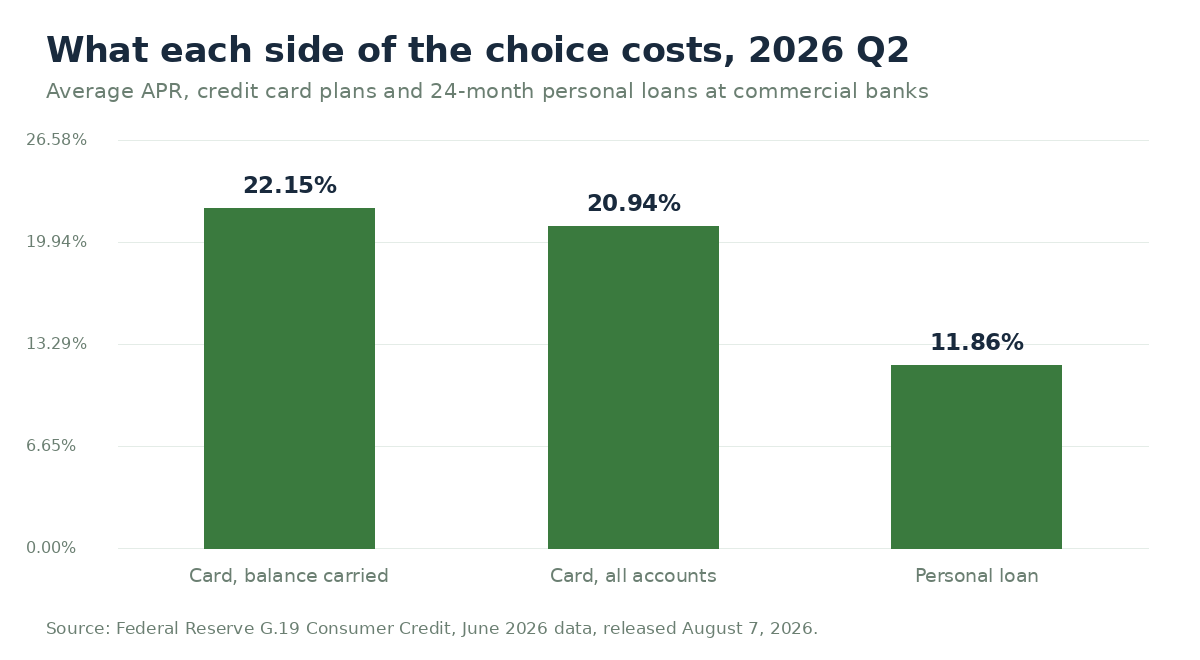
Both are priced against the same alternative. G.19, released August 7, 2026, puts the second-quarter average on card accounts assessed interest at 22.15 percent and the average on a two-year bank personal loan at 11.86 percent.
Which one wins is arithmetic, and the arithmetic hinges on one input that almost no comparison article asks about. Start with the math, and that input becomes obvious.
The four options, costed on one balance
An $8,000 balance, a payment of $400 a month held constant, and no new charges. These are round illustrative numbers chosen to show the mechanism, not market averages. Transfer fees are shown at 3 and 5 percent because fee terms vary by offer; the promotional window is set at 15 months and the go-to rate after it at 22.15 percent.
| Option | Months to clear | Total cost of credit |
|---|---|---|
| Carry the balance at 22.15% | 26 | $2,076 |
| Transfer, 3% fee, 0% for 15 months | 21 | $386 |
| Transfer, 5% fee, 0% for 15 months | 22 | $568 |
| 24-month loan at 11.86% | 23 | $958 |
Total cost of credit includes the transfer fee where one applies. Interest compounded monthly on the declining balance. Reproduce with any amortization calculator.
At a $400 payment the transfer wins clearly, and it wins on the fee being a one-time charge against a balance that gets retired inside the window. Even at a 5 percent fee it costs about a quarter of what carrying the balance costs.
The input the comparison actually turns on
That $400 payment is doing the work in every row of the table. Change it and the ranking changes with it.
Run the same $8,000 at $200 a month. Carrying the balance at 22.15 percent takes 74 months and costs about $6,661. The 3 percent transfer with a 15-month window takes 52 months and costs about $2,227. The transfer still wins, but look at what happened to it: the promotional window closes in month 15 with most of the balance still outstanding, and the remainder reverts to the go-to rate for another three years. The one-time fee bought fifteen months of relief on a balance that needed fifty-two.
That is the structural difference between the two products. A transfer prices a window; a loan prices a term. A window that ends before the balance does hands the remainder back to the original rate, while a term that ends before the balance does is not a thing that happens, because the term is set to retire it.
So the real question is whether a payment large enough to clear the balance inside the promotional window is realistic, month after month, for the whole window. Divide the balance by the number of promotional months. If that figure is not comfortably affordable, the transfer is being priced on an assumption the household cannot meet, and the fixed-term loan is the more conservative structure even at a higher headline cost.
Minimum-payment-only behavior sits at its highest level since at least 2015, per the CFPB’s 2025 Consumer Credit Card Market Report of December 30, 2025. Populations under that much payment pressure are exactly the ones for whom a promotional window is likeliest to expire with a balance still on it.
The allocation rule that protects you, and the part of it that does not
Anyone who transfers a balance and then uses the same card for purchases should know how the payment gets split, because federal law decides part of it and the issuer decides the rest.
Under Regulation Z, 12 CFR 1026.53(a), whatever is paid above the required minimum has to go against the highest-rate balance first, and only then down the rate ladder. On a card holding a 0 percent transfer balance and new purchases at the go-to rate, every dollar above the minimum attacks the purchases first. That is the protective half, and it is the opposite of the pre-2009 practice the CARD Act was written to end.
The regulation is explicit that it does not govern how the required minimum itself is allocated. The issuer can apply the minimum where it chooses, subject to the card agreement. A cardholder paying only the minimum on a card with both balances can therefore see that payment land against the promotional balance while the purchases accrue at the full rate.
There is a related special rule at 1026.53(b)(1) for balances under a deferred interest program, where in the two billing cycles before the promotional period expires the excess payment must go to the deferred interest balance first. Deferred interest is a different product from a standard 0 percent transfer, and the distinction is worth confirming on the offer terms rather than assuming.
The clean operating rule that follows: do not spend on the transfer card. Keep the transferred balance alone on an account with no other activity, and the allocation question never has to be answered.
Each product leaves a different mark on the account
The cost table treats these as two prices for the same service. They also leave the borrower in structurally different positions.
A consolidation loan converts revolving debt into installment debt. The payment is fixed, the end date is on the paperwork, and the discipline is built into the product. The old card remains open with its full limit and a zero balance, which is the failure mode: the household now has an installment payment and an empty card, and nothing structural stops the card from refilling.
A transfer keeps everything revolving. There is no fixed end date, only a promotional expiry, and the minimum payment on the new card is typically small enough that the window can close with a balance still sitting on it unless the cardholder overrides it. The transfer requires a repayment schedule the borrower imposes on themselves. The loan comes with one.
Approval also differs. A transfer offer at 0 percent generally requires good credit and comes with a transfer limit that may be lower than the balance being moved, which leaves a remainder behind at the original rate and quietly changes the math in the table above. Where the file is damaged, the realistic options are covered in borrowing with damaged credit.
Why the offer exists at all
An issuer offering 15 months at 0 percent is paying real money for that balance. It gives up the interest, absorbs the acquisition cost, and collects a single-digit fee against it. The economics only work if a meaningful share of transferred balances is still there when the promotional rate ends.
That is a description of what the product is priced to expect rather than a reason to distrust it, and it tells you exactly which behavior makes you the profitable customer. Cardholders were assessed $160 billion in interest during 2024, against $105 billion two years earlier, on the Bureau’s own accounting. That figure is the revenue line these offers are recruiting into.
Which makes the offer terms the part to read closely, before the application rather than after approval. Five of them change the arithmetic:
- The transfer fee, as a percentage and as a dollar amount on your actual balance.
- The length of the promotional window, in months, and whether it runs from account opening or from the transfer posting.
- The go-to rate that applies to whatever remains when the window closes.
- The transfer deadline, since many offers require the transfer to be completed within a set period after the account opens.
- The approved transfer limit, which may be lower than the balance and can leave a remainder behind at the original rate.
One more, which applies mainly to consolidation loans: whether the loan carries an origination fee deducted from the proceeds. A $10,000 loan that funds $9,700 is a $10,000 debt, and the fee belongs in the cost comparison alongside the rate.
The default that fits most balances
Divide the balance by the number of promotional months on offer. If that payment fits the budget with room to spare, the transfer is usually the cheaper instrument, and the fee is a one-time toll rather than a rate. If it does not fit, the fixed-term loan buys a structure the household can actually complete, and paying $958 instead of $386 for a schedule that finishes is a rational purchase.
Either way the decision that matters comes before both of them: what happens to the card once the balance leaves it. The sequencing that follows is worked through in getting out of debt faster.

Sources
4
Every figure in this article traces to a government record or to a named independent, non-commercial research body. We do not cite insurance marketplaces or affiliate comparison sites for data.
- Board of Governors of the Federal Reserve System G.19 Consumer Credit, June 2026 data Published 2026-08-07Supports: Credit card APR on accounts assessed interest for 2026 Q2 and the 24-month personal loan rate at commercial banks
- Consumer Financial Protection Bureau Regulation Z, 12 CFR 1026.53, Allocation of payments Published 2026-08-28Supports: Allocation of amounts above the required minimum to the highest APR balance first, the absence of any requirement governing allocation of the minimum itself, and the deferred interest special rule for the final two billing cycles
- Consumer Financial Protection Bureau The Consumer Credit Card Market, 2025 report to Congress Published 2025-12-30Supports: Share of cardholders making only the minimum payment at its highest since at least 2015, and $160 billion in interest assessed in 2024 against $105 billion in 2022
- Office of the Federal Register Consumer Credit Card Market Report of the Consumer Financial Protection Bureau, 2025, 91 FR 504 Published 2026-01-07Supports: Published summary of the 2025 CFPB card market report findings on minimum payments and interest assessed
Figures last verified August 28, 2026.