

A 24-month personal loan at a commercial bank averaged 11.86 percent in the second quarter of 2026, per the Federal Reserve’s G.19 release of August 7, 2026. That average describes loans that were approved and priced. It is the number a borrower with a damaged file is being measured against, and usually quoted above.
Borrowing after a rough stretch is mostly a pricing problem rather than an access problem. Credit is available at almost every level of risk. What changes is the rate, the term, whether collateral is required, and how much room there is to get anything wrong afterward.
Here is the sequence that produces the best available terms, followed by the federal rule that identifies the specific offer nobody should accept.
Read the file before anyone else does
Under federal law you can obtain your credit reports from each of the nationwide reporting agencies at no cost through AnnualCreditReport.com. Pull all three before applying anywhere, because the file is what gets priced and the three do not always agree.
Do two things with them. Confirm that the negative items are accurate, since an error corrected before an application is worth considerably more than one corrected after a denial. Then look at the dates, because most negative information has a limited reporting life and an item close to falling off changes the calculus on whether to apply now or wait a quarter.
A file can also be damaged in a way that looks like something else entirely. The CFPB’s June 2025 technical correction found that a large share of adults previously counted as having no credit record at all in fact hold records that scoring models will not score, either because the information is stale or because there is too little of it. The remedy for a thin file is not the remedy for a damaged one, and the report tells you which you are holding. That distinction is worked through in building credit from zero.
What a damaged file actually changes at the underwriting desk
Underwriting prices uncertainty. A file with missed payments is evidence pointing the wrong way, and lenders respond on four dials: a higher rate, a shorter or longer term, a demand for collateral, and a lower approved amount.
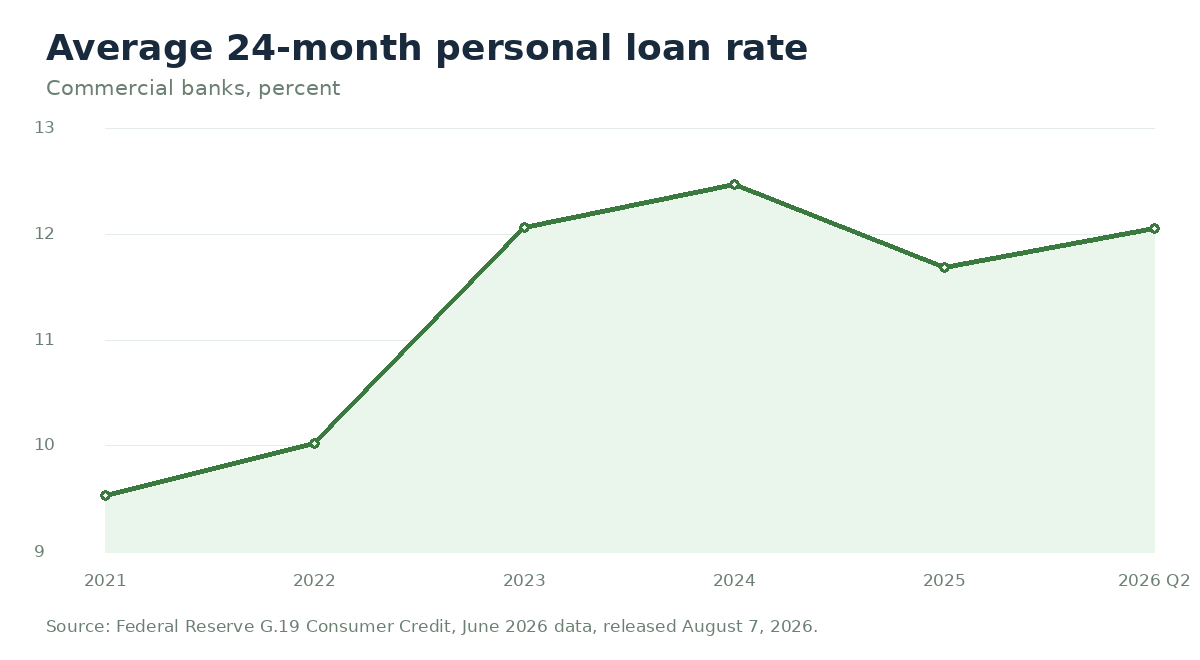
The term dial is the one that does the quiet damage. Stretching a loan lowers the monthly payment and raises the total cost, which is why a finance conversation that stays fixed on the payment is a conversation about the wrong number. Ask what the loan costs in total dollars across its full term, then compare offers on APR rather than on the monthly figure.
Approval volumes also move with the credit cycle rather than with any one applicant. The CFPB’s 2025 report counted over 153 million credit card applications in 2024, down from more than 160 million in 2022 and 2023, with new account originations down 19 percent from 2022 to 89 million. Applying into a tightening market with a damaged file can produce a run of denials that says more about the quarter than about the borrower.
Which argues for applying deliberately rather than broadly. Each application is recorded, and a scattergun week of them leaves a visible pattern in the file that the next lender reads.
The federal credit union product almost nobody is told about
Federal credit unions can offer payday alternative loans, a category the National Credit Union Administration built into its general lending rule specifically as a substitute for high-cost short-term credit. The terms are set in regulation at 12 CFR 701.21(c)(7), which is why they can be stated precisely rather than shopped.
Under the PALs I provisions, principal runs from $200 to $1,000 and the credit union may charge an interest rate up to 1,000 basis points above the NCUA’s general usury ceiling. With that ceiling at 18 percent, the maximum is 28 percent inclusive of all finance charges. A reasonable application fee is permitted, capped at $20. Under the PALs II provisions added in 2019, the loan may run up to $2,000 with a term of one to twelve months, and may be made as soon as the borrower establishes membership.
The rest of the framework matters as much as the rate cap. These loans must be fully amortizing, rollovers are prohibited, and the rule limits how many a member may take within a rolling period. Compare that with a product designed to be renewed: 28 percent on a twelve-month amortizing loan is expensive credit, and it is a different category of expensive from a balance that resets every payday.
Two limits belong on this. The product is offered by federal credit unions, not by every institution calling itself a credit union, and no credit union is required to offer it. Membership eligibility comes first, and the question to ask by name is whether the branch runs a PALs program.
Collateral and cosigners move the risk somewhere
The two standard ways to get a better rate on a damaged file both work by giving the lender something to fall back on.
Collateral converts an unsecured loan into a secured one. The rate improves because the lender’s loss on default shrinks, and the borrower’s loss on default grows by exactly the asset pledged. A share-secured loan against savings, a title loan against a vehicle and a home equity line are all the same transaction at different levels of severity, and the severity is the part to weigh. Pledging a car to consolidate credit card debt converts an obligation that cannot repossess anything into one that can.
A cosigner does the same thing with a person instead of an asset. A cosigner is jointly liable rather than a character reference. The account typically appears on their credit file, and a missed payment lands on both records. Have that conversation in the lender’s terms before signing, not after the first late notice.
Where a household is borrowing to pay other debts rather than to buy something, the more useful comparison is against restructuring what already exists, which is priced out in getting out of debt faster.
Shop the rate without shopping the file to pieces
Most lenders will run a prequalification against a soft inquiry, which returns an indicative rate without the application being recorded as a credit inquiry. Use it. It is the only way to compare pricing across several lenders before committing the file to any of them.
Understand what comes back, though. A prequalified rate is an estimate produced from a soft pull and limited information, and the binding number arrives after full underwriting verifies income, employment and the full file. A quoted rate that improves at closing is rare. One that worsens is the reason to have a second offer in hand.
Stress-test the payment before signing it
Aggregate delinquency ran at 4.7 percent of outstanding balances in the second quarter of 2026, while the share of auto balances moving into serious delinquency rose from 2.93 percent a year earlier to 3.00 percent, per the New York Fed’s household credit report of August 11, 2026. New delinquencies in card and auto lending have not come back down with the aggregate figure.
Every one of those transitions began with a loan somebody could afford on the day they signed it. Underwriting tests whether the payment fits today, not what happens to it when hours get cut or a second obligation lands in the same month.
So run the test yourself before signing: subtract the new payment from the month where income was lowest in the past year, not from an average month. A loan that only clears on an average month is a loan priced against a household’s good quarters.
The rule that identifies the offer to walk away from
A borrower with a damaged file gets marketed to heavily, and one specific pitch is already illegal in the form it usually arrives.
The Federal Trade Commission’s Telemarketing Sales Rule, at 16 CFR 310.4(a)(4), makes it an abusive practice to request or receive payment of any fee or consideration in advance of obtaining a loan or other extension of credit when the seller or telemarketer has guaranteed or represented a high likelihood of success in obtaining or arranging that credit.
The violation lives in the combination. A fee charged before funding is ordinary in parts of lending. A guarantee of approval is a sales claim. The two arriving in the same phone call, from an operation that has promised approval and then asked for money before delivering it, is the conduct the rule names.
The practical test takes one question: what do you need from me before the money is in my account? An origination fee deducted from the proceeds at funding is a normal structure. A processing fee, insurance premium, first payment, or good-faith deposit wired ahead of an approval that was already promised is the pattern the FTC wrote the provision around, and it does not become legitimate because the caller has your address, your employer, or a file number.
The same rule governs the debt relief side of this market on a parallel track, with its own fee-timing conditions set out at 16 CFR 310.4(a)(5)(i). Those are covered in debt relief, priced honestly.
Borrowing on a damaged file is expensive and generally survivable. Borrowing on a damaged file from whoever called first is how a bad quarter becomes a bad three years.
Frequently asked questions
What is the first step before applying for a loan with damaged credit?
Pull free reports from all three nationwide agencies at AnnualCreditReport.com. Confirm negatives are accurate (errors fixed before an application beat denials), note how close items are to falling off, and check whether you are actually thin/stale rather than damaged—the CFPB June 2025 credit invisibles technical correction shows many adults sit in unscored categories.
What does a damaged file change at underwriting?
Lenders reprice uncertainty on four dials: higher rate, different term, collateral demands, and lower approved amount. Compare offers on APR and total dollars over the full term—not only the monthly payment. The commercial-bank 24-month personal-loan average in the Federal Reserve G.19 Consumer Credit release is the benchmark approved loans clear, not the rate a damaged file is offered.
What are federal credit union payday alternative loans (PALs)?
Under the NCUA payday alternative loan rule at 12 CFR 701.21(c)(7), PALs I principals run $200–$1,000 with interest up to 1,000 basis points above the NCUA usury ceiling (28 percent inclusive of finance charges when the ceiling is 18 percent) and an application fee capped at $20. PALs II can go to $2,000 with one- to twelve-month terms. Loans must fully amortize; rollovers are prohibited. Not every credit union offers them.
How do I shop rates without shredding the file with hard inquiries?
Use soft-pull prequalification to collect indicative rates before any hard application. Treat those quotes as estimates: the binding APR arrives after full underwriting verifies income, employment, and the full file. Keep a second offer ready because worsening at closing is more common than improvement.
What federal rule flags an advance-fee loan scam?
The FTC Telemarketing Sales Rule at 16 CFR 310.4(a)(4) makes it an abusive telemarketing practice to request or receive a fee in advance of obtaining credit when the seller has guaranteed or represented a high likelihood of success. Ask: what do you need from me before money is in my account? A fee wired ahead of a promised approval is the pattern to walk away from.
How should I stress-test a new loan payment?
Subtract the new payment from your lowest-income month in the past year, not from an average month. Aggregate delinquency was 4.7 percent of outstanding balances in 2026 Q2 per the New York Fed Quarterly Report on Household Debt and Credit, and serious auto delinquency edged up year over year—reminders that loans that only clear on good months fail in bad ones.
When do collateral or a cosigner actually help?
Both improve pricing by giving the lender something to fall back on. Collateral converts unsecured risk into secured risk (your asset is on the line). A cosigner is jointly liable—not a character reference—and missed payments typically hit both files. Have that conversation in the lender’s terms before signing.
Why can a tightening credit cycle produce a run of denials?
Approval volumes move with the market. The CFPB 2025 Consumer Credit Card Market report counted over 153 million card applications in 2024 (down from more than 160 million in 2022–2023) and new originations down 19 percent from 2022 to 89 million. Applying broadly into a tight quarter can leave a visible inquiry pattern that the next lender reads.
How is borrowing with bad credit different from starting with no credit?
No credit is missing evidence; damaged credit is adverse evidence. Remedies differ: thin/invisible files need reporting tradelines (see building credit from zero and first credit card with no credit file), while damaged files need accuracy, timing, deliberate soft-pull shopping, and sometimes collateral—not another scattergun week of applications.
When is restructuring existing debt better than a new loan?
When the household is borrowing mainly to pay other debts rather than to buy something. Compare total cost and collateral risk against reshaping what already exists—worked through in getting out of debt faster—before pledging a car or home to consolidate revolving balances.

Sources
7
Every figure in this article traces to a government record or to a named independent, non-commercial research body. We do not cite insurance marketplaces or affiliate comparison sites for data.
- Board of Governors of the Federal Reserve System G.19 Consumer Credit, June 2026 data Published 2026-08-07Supports: Average rate on 24-month personal loans at commercial banks for 2026 Q2
- National Credit Union Administration 12 CFR 701.21(c)(7), Loans to members, payday alternative loans Published 2026-08-28Supports: PALs I principal range of $200 to $1,000, the 1,000 basis point allowance above the general usury ceiling, the $20 application fee cap, full amortization, the rollover prohibition and the limit on loans per member
- Office of the Federal Register Payday Alternative Loans, final rule, 84 FR 51942 Published 2019-10-01Supports: The 28 percent maximum inclusive of all finance charges given an 18 percent usury ceiling, and the PALs II terms of up to $2,000 with a one to twelve month maturity available immediately on membership
- Federal Trade Commission 16 CFR 310.4(a)(4), Telemarketing Sales Rule, abusive telemarketing acts or practices Published 2026-08-28Supports: The prohibition on requesting or receiving a fee in advance of obtaining a loan where the seller or telemarketer has guaranteed or represented a high likelihood of success
- Consumer Financial Protection Bureau The Consumer Credit Card Market, 2025 report to Congress Published 2025-12-30Supports: Over 153 million credit card applications in 2024 against more than 160 million in 2022 and 2023, and new account originations down 19 percent from 2022 to 89 million
- Consumer Financial Protection Bureau Technical correction and update to the CFPB's credit invisibles estimate Published 2025-06-23Supports: The reclassification of adults from credit invisible to unscored by stale or insufficient information
- Federal Reserve Bank of New York Quarterly Report on Household Debt and Credit, 2026 Q2 Published 2026-08-11Supports: Aggregate delinquency at 4.7 percent of outstanding debt and the auto serious-delinquency transition rate rising from 2.93 to 3.00 percent year over year
Figures last verified August 28, 2026.