

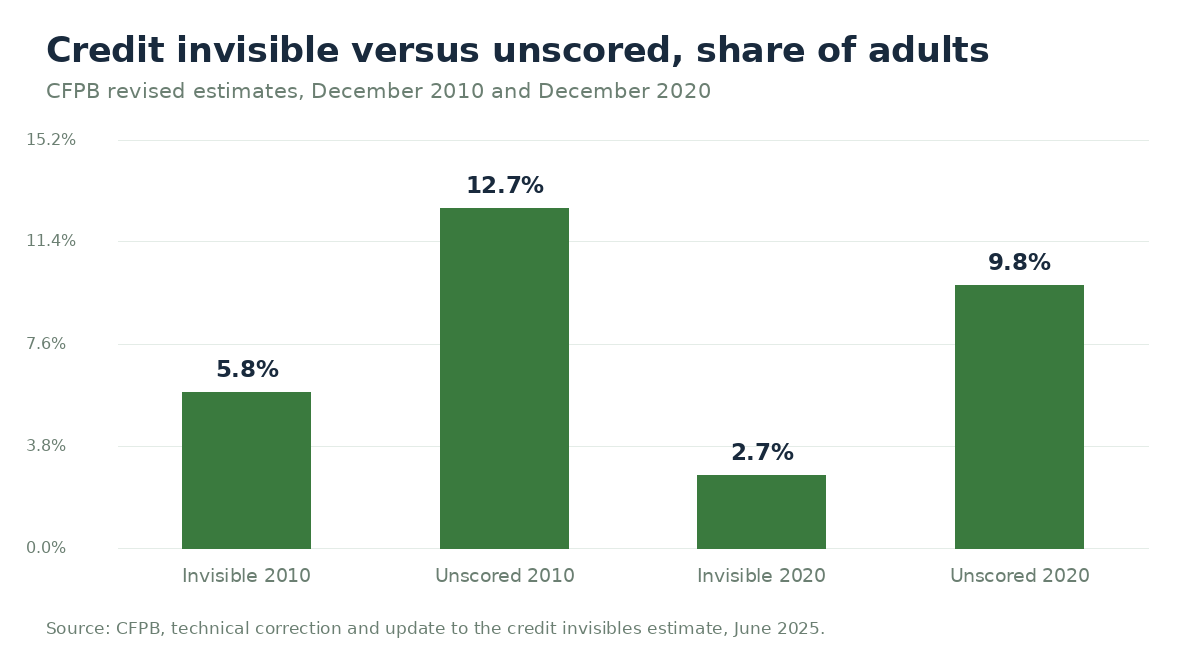
In June 2025 the Consumer Financial Protection Bureau published a correction to its own most-quoted statistic. The 2015 finding that 26 million American adults were credit invisible, repeated in roughly every beginner’s guide to credit written since, was wrong. The Bureau’s revised estimate for that same year, December 2010, is 13.5 million people, or 5.8 percent of adults. For December 2020 the figure is 2.7 percent, about 7.0 million.
The correction matters to anyone starting from nothing, because the Bureau moved most of those people into a different category, and that category calls for a different response.
What the Bureau got wrong, in its own words
The 2015 report drew on a credit-record sample that, the Bureau later discovered, left out records containing only deferred student loans, collections, or closed accounts. Those people had credit records. The sample simply could not see them, so they were counted as having no record at all. A second issue ran the other way: the original analysis treated records consisting only of credit inquiries as credit records, when an inquiry shows no history of credit use.
Correcting both, using a newer 2 percent sample called the Consumer Credit Information Panel, cut the 2010 credit invisible estimate roughly in half and pushed the difference into the unscored column. The share of adults with an unscored credit record in December 2010 was revised upward from 7.4 percent to 12.7 percent, or 29.7 million people.
The publishing side of that story is its own lesson. A federal agency published a number, watched it become the industry’s standard citation for a decade, found the error itself and published the correction. Publishers that built content on the original figure have mostly not updated it.
Invisible and unscored are two different problems
Credit invisible means no credit record exists at the nationwide reporting agencies. Unscored means a record exists but a scoring model will not produce a score from it, either because the information is stale, meaning nothing recent has been reported, or insufficient, meaning too few accounts with enough payment history.
| Share of US adults | Dec 2010, as revised | Dec 2020 |
|---|---|---|
| Scored credit record | 81.6% | 87.5% |
| Unscored, stale information | 7.6% | 5.9% |
| Unscored, insufficient information | 5.1% | 3.9% |
| No credit record at all | 5.8% | 2.7% |
Source: CFPB, Technical correction and update to the CFPB’s credit invisibles estimate, June 2025. Columns may not sum to 100 percent due to rounding.
Read the two unscored rows together. In 2020 they total 9.8 percent of adults, which against the 258 million adults the report uses works out to roughly 25 million people. That is more than three times the number with no record at all.
The practical difference is what the first move looks like. Someone with no record needs an account that reports, full stop. Someone whose record went stale may already have a closed account or an old collection sitting in the file, and needs recent reported activity for the model to have something current to read. The file itself tells you which of the two positions you are in.
How people actually get a first credit record
The Bureau studied this directly in a June 2017 report on how consumers transition out of credit invisibility. The findings are a decade old now and the market has moved, but the structure of how a first record gets created has not changed much, and it is more useful than the advice usually offered.
Credit cards were the entry product for 37.6 percent of newly credit visible consumers, more than any other product, with student loans next. Almost 80 percent of consumers who became credit visible did so before age 25, and consumers in low- and moderate-income neighborhoods who made that transition did so at older ages than consumers in middle- or upper-income neighborhoods.
Two findings from that study deserve more attention than they get.
The first is that roughly one in four consumers acquired their first credit history through an account for which somebody else was also responsible, either as a co-borrower or as an authorized user on another person’s account. That route was notably less common in lower-income neighborhoods. Access to a creditworthy relative is itself an advantage, distributed unevenly, and it is doing a meaningful share of the work in the credit-building story.
The second is that secured credit cards, the product recommended in almost every beginner’s guide, accounted for only 5.6 percent of the credit cards that served as entry products, which is 2.1 percent of all consumers in the study’s sample. The standard recommendation and the observed behavior diverge. Secured cards can still be sound advice, but they were a niche path into the system rather than the main road.
The study also found that consumers in lower-income neighborhoods were more likely than those in higher-income neighborhoods to acquire a credit record from non-loan items such as third-party collections. A first credit record created by a collection account is a worse starting position than no record at all, because the model now has something to read and what it reads is negative.
Alternative data is widening the front door
The CFPB’s 2025 Consumer Credit Card Market Report, released December 30, 2025 and reported to Congress in January 2026, notes that the use of alternative data such as bank account cash flow information is helping expand credit card access, particularly for consumers with limited credit history.
In plain terms: some issuers now look at how money moves through a checking account rather than only at a credit file. That does not replace a credit record, and an approval driven by cash flow data still only helps build one if the resulting account reports to the nationwide agencies. But it does mean an application with a thin file is not automatically a dead end at every issuer, which was closer to true a decade ago.
The same report puts the average APR on general purpose credit cards at 25.2 percent in 2024, the highest level since at least 2015. A card opened to build a record is an expensive way to borrow if a balance is carried on it.
The first move, and the order after it
Start by finding out which of the two problems you have. Federal law entitles consumers to free copies of their credit reports from the nationwide reporting agencies through AnnualCreditReport.com, the site established under that law. A report that comes back empty and a report that comes back with one old collection call for different first moves, and guessing between them wastes months.
From there the sequence is unglamorous. Open one account that reports to the nationwide agencies and confirm before opening it that it does report, because products that do not report build nothing. Use it small and pay it in full monthly, which means the account shows activity without generating interest at 25 percent. Then leave it alone. A credit record is built by time plus reported payment history, and there is no version of this that finishes quickly.
If a co-borrower or authorized user arrangement is available to you, the CFPB data says it is a common route. It also transfers risk in both directions: the primary account holder’s late payment can land on the newer record too. That conversation belongs at the front, not after the first missed due date.
The moves that build nothing
Paying cash for everything builds nothing, which is the uncomfortable part of the system. A record of never borrowing is not a record of borrowing well.
A debit card builds nothing, because no credit is extended. Rent and utility payments generally do not appear on a credit report by default, though some programs report them if you enroll. Checking your own credit report does not damage it. And no legitimate lender promises credit before reviewing an application, which is worth remembering when a thin file starts attracting offers.
Starting-out questions
How long until I have a score?
Scoring models generally require a minimum amount of history before they will generate a score, and the exact threshold differs by model because each uses its own proprietary definition of a scorable record. The CFPB has been explicit about that variation. Expect months rather than weeks, and expect the first score to be based on very little.
Is a secured card the right first product?
It can be a reasonable one. A deposit reduces the lender’s loss if the borrower defaults, which is why the product exists for applicants who look riskier on paper. Just weigh it against the finding above that it was a small minority of actual entry products, and confirm the specific card reports to all three nationwide agencies before opening it.
Does having no credit history mean I have bad credit?
No. They are different states. A lender evaluating an empty file has no evidence either way and typically prices for that uncertainty. A lender evaluating a damaged file is pricing evidence. The absence of a record is a smaller hole than a record full of missed payments, and it fills faster. A file that is damaged rather than empty gets priced on different terms, and borrowing with damaged credit takes that case.
Why do the numbers in older articles look so different?
Because most of them cite the 2015 estimate the Bureau corrected in June 2025. If a guide still says 26 million Americans are credit invisible, it was written before the correction or written without checking, and the figures above are the ones the agency currently stands behind.
Frequently asked questions
Why did the CFPB cut the credit-invisible estimate roughly in half?
The 2015 sample missed records that contained only deferred student loans, collections, or closed accounts, and it treated inquiry-only files as full credit records. Correcting both with the Consumer Credit Information Panel moved millions from “invisible” into unscored. See the CFPB June 2025 credit invisibles technical correction.
In 2020, how large was the unscored group compared with no record at all?
Unscored stale (5.9 percent) plus unscored insufficient (3.9 percent) totaled about 9.8 percent of adults—roughly 25 million people on the report’s 258 million adult base—more than three times the 2.7 percent with no record. Source: CFPB June 2025 credit invisibles technical correction.
What product most often creates a first credit record?
In the CFPB Data Point: Becoming Credit Visible study, credit cards were the entry product for 37.6 percent of newly credit-visible consumers—more than any other product—with student loans next. Almost 80 percent became credit visible before age 25.
How common is becoming credit visible through someone else’s account?
Roughly one in four consumers in the CFPB Data Point: Becoming Credit Visible sample acquired first history as a co-borrower or authorized user. That route was less common in lower-income neighborhoods, so access to a creditworthy relative is itself an uneven advantage.
Were secured cards the main observed path into the system?
No. Secured cards accounted for only 5.6 percent of the credit cards that served as entry products in the CFPB Data Point: Becoming Credit Visible sample (about 2.1 percent of all consumers studied). They can still be sound advice for applicants who need deposit-backed approval—just confirm three-bureau reporting before you open one.
How is alternative data changing first-card access?
The CFPB 2025 Consumer Credit Card Market report notes issuers increasingly use cash-flow and other alternative data to extend cards to consumers with limited history. An approval still only builds a file if the resulting account reports to the nationwide agencies.
Which everyday payments build nothing by default?
Paying cash, using a debit card, and most rent or utility payments do not appear on nationwide credit reports unless you enroll in a reporting program that actually furnishes data. Checking your own report does not damage it. No legitimate lender promises credit before reviewing an application.
What first move should I take once I know my file state?
Open one account that reports to the nationwide agencies—and confirm reporting before you open it. Use it small, pay in full monthly, then leave it alone. Time plus clean payment history is the mechanism; there is no fast version. Card product choice is secondary to reporting behavior—see also first credit card with no credit file.
Why can a first record created by a collection be worse than no record?
The CFPB Data Point: Becoming Credit Visible research found lower-income neighborhoods were more likely to enter the system via non-loan items such as third-party collections. The model then has something to read, and what it reads is negative—so the starting position is worse than a blank file.
How should authorized-user arrangements be handled up front?
They are a common entry path, but risk transfers both ways: the primary’s late payment can land on the newer record too. Confirm the issuer reports authorized users, agree on payment rules before the add, and treat a missed due date as a shared problem—not a surprise after the fact.

Sources
4
Every figure in this article traces to a government record or to a named independent, non-commercial research body. We do not cite insurance marketplaces or affiliate comparison sites for data.
- Consumer Financial Protection Bureau Technical correction and update to the CFPB's credit invisibles estimate Published 2025-06-23Supports: The revised 2010 and 2020 shares of adults who are credit invisible, scored, and unscored by stale or insufficient information, the cause of the original error, and the 258 million adult population base
- Consumer Financial Protection Bureau Data Point: Becoming Credit Visible Published 2017-06-07Supports: Credit cards as the entry product for 37.6 percent of newly credit visible consumers, secured cards as 5.6 percent of those, the roughly one in four who begin via a co-borrower or authorized user account, the share becoming visible before age 25, and neighborhood income differences including entry via collections
- Consumer Financial Protection Bureau The Consumer Credit Card Market, 2025 report to Congress Published 2025-12-30Supports: Alternative data such as cash flow information expanding card access for consumers with limited credit history, and the 25.2 percent average general purpose card APR in 2024
- Office of the Federal Register Consumer Credit Card Market Report of the Consumer Financial Protection Bureau, 2025, 91 FR 504 Published 2026-01-07Supports: Publication date of the 2025 CFPB card market report and its summarised findings on cost of credit and product innovation
Figures last verified August 28, 2026.