

The average rate on a 60-month new car loan at commercial banks was 7.14 percent in the second quarter of 2026, according to the Federal Reserve’s G.19 consumer credit release published on August 7, 2026. Two years earlier the same series read 8.16 percent. Rates on car loans have come off their peak.
That is the smaller of the two changes. The larger one is that federal tax law now treats car loan interest differently than it has since 1986, and 2026 is the first tax year in which lenders are required to document it on a form built for the purpose.
Three things moved. Here they are in order of how much money they actually shift.
The deduction, and the exclusions that define it
IRS Publication 6126, issued January 2026, describes a deduction for interest paid on a loan used to buy a new personal-use vehicle. The maximum is $10,000 a year. It is available whether a household itemizes or takes the standard deduction, and the vehicle identification number must appear on the return for any year the deduction is claimed.
The qualifying conditions are where most car buyers fall out. Per Publication 6126, a qualified vehicle is a car, minivan, van, SUV, pickup truck or motorcycle with a gross vehicle weight rating under 14,000 pounds that underwent final assembly in the United States. The interest must be paid on a loan for a vehicle that is new, for personal use, and purchased after December 31, 2024. The deduction phases out for taxpayers with modified adjusted gross income above $100,000, or $200,000 for joint filers.
Look at that list again for what it removes. Used vehicles are out. A vehicle assembled outside the United States is out regardless of the badge on the grille, which is why the IRS points buyers at the vehicle’s information label, the VIN, or the National Highway Traffic Safety Administration VIN decoder rather than at the brand. Loans that closed in 2024 or earlier are out even if payments continue.
A tax deduction behaves like a coupon with conditions you have to satisfy at filing time, months after the salesperson has stopped returning calls, and its value depends on a marginal tax rate rather than on the sticker.
What the deduction is worth, calculated
Take a $40,000 balance financed for 60 months at 7.14 percent, the G.19 second-quarter 2026 commercial bank rate. The $40,000 is a round illustrative number chosen to show the mechanism, not a market average.
The monthly payment on those terms is about $795. Over the first twelve months the borrower pays roughly $9,540 and retires roughly $6,900 of principal, so about $2,630 of that first year is interest. A household in the 22 percent federal bracket that qualifies in full would see federal tax reduced by roughly $580 for the year. In year five, when the balance is small, the same deduction is worth a fraction of that, because there is far less interest left to deduct.
Two observations follow. The benefit is front-loaded, and it is a reduction in taxable income rather than a credit, so the same interest is worth less to a household in a lower bracket. Any figure a dealership quotes for what this deduction is worth is an estimate about someone else’s tax return.
The form that shows up in early 2027
The IRS created a dedicated information return for this deduction, Form 1098-VLI, Vehicle Loan Interest. The draft instructions issued for the form cover calendar year 2026 and later years. A lender or other business that receives $600 or more of interest on a specified passenger vehicle loan during the year files the form, and the draft instructions are explicit that it is not filed unless the loan was secured by a first lien on the vehicle when the loan was made.
For 2025 the IRS granted transition relief under Notice 2025-57, acknowledging that lenders did not yet have the reporting systems built. The deduction arrived a year ahead of the form that documents it, which is a sequencing choice with a predictable consequence: 2025 claims often rested on whatever annual interest statement a lender happened to produce.
One caveat belongs on this section. Treasury and the IRS issued the implementing rules as proposed regulations, published in the Federal Register on January 2, 2026, with public comments invited through February 2, 2026. Proposed regulations can change before they are finalized, so the operational details around reporting may shift. The statutory terms in Publication 6126 are the stable part.
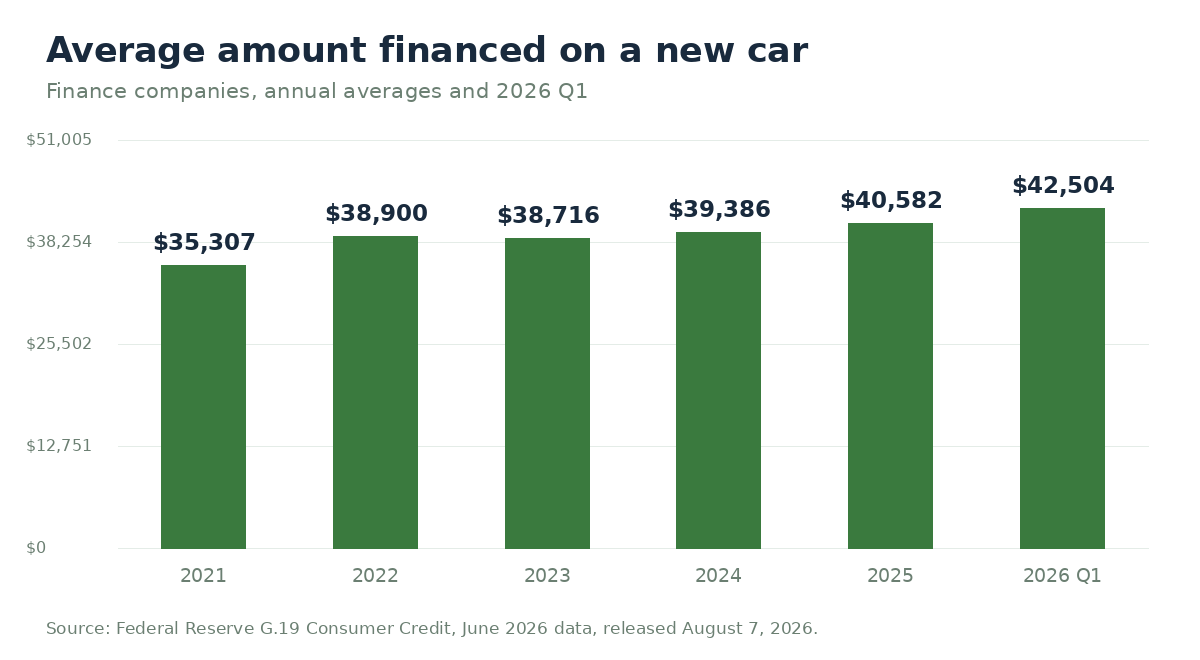
Rates fell. The amount financed did not.
The G.19 release tracks both what borrowing costs and how much people borrow, and in this cycle the two moved in opposite directions.
| Measure | 2021 | 2024 | Latest |
|---|---|---|---|
| New car loan, 60 months, commercial banks | 4.82% | 8.16% | 7.14% (2026 Q2) |
| New car loan, 72 months, commercial banks | 4.82% | 8.29% | 6.97% (2026 Q2) |
| Amount financed, new car, finance companies | $35,307 | not shown here | $42,504 (2026 Q1) |
Source: Federal Reserve G.19 consumer credit release, June 2026 data, published August 7, 2026.
Put the two columns together. Financing $35,307 over 60 months at 4.82 percent produces a payment near $663. Financing $42,504 over the same term at 7.14 percent produces a payment near $844. The rate came down more than a full point from its 2024 peak and the monthly payment still landed about $181 higher, because the principal grew by roughly $7,200.
One honest qualification: the amount financed figures come from the G.19 finance company series while the rates come from the commercial bank series, so this pairing illustrates direction rather than a like-for-like account. G.19 also reports a 66-month average maturity on new car loans at finance companies in the first quarter of 2026, which is how a larger principal gets turned into a payment somebody will sign.
Delinquency is the number lenders are watching now
Auto loan balances reached $1.71 trillion in the second quarter of 2026, up $28 billion, on $211 billion of new originations, according to the New York Fed’s quarterly household credit report published August 11, 2026. Total household debt came to $18.8 trillion, down $13 billion, with aggregate delinquency at 4.7 percent of outstanding debt.
Inside that broadly stable picture, the auto line moved the wrong way. The share of auto balances transitioning into serious delinquency rose from 2.93 percent in the second quarter of 2025 to 3.00 percent in the second quarter of 2026. The New York Fed’s researchers describe new delinquencies on auto loans and credit cards as remaining elevated.
That combination, cheaper rates alongside larger balances and rising auto delinquency transitions, is consistent with longer terms and bigger principals doing what longer terms and bigger principals typically do. A lower rate on a larger loan over more months can still produce a payment a household cannot carry through a bad quarter.
Four things to check before signing
Check the assembly point, not the brand. The IRS directs buyers to the vehicle’s information label, the VIN, or the NHTSA VIN decoder. Plenty of vehicles from non-US manufacturers undergo final assembly in the United States, and plenty of vehicles from US manufacturers do not.
Confirm the loan structure matches the rule. The deduction attaches to a purchase loan on a new vehicle bought for personal use. A lease is not a purchase. Per Publication 6126, interest paid on the refinanced amount is generally eligible if a qualifying loan is later refinanced.
Ask for the amount financed and the total finance charge as separate numbers. A finance office negotiates in monthly payments because a payment can be lowered by stretching the term while the total cost rises. The amount financed and the finance charge are the two figures that make that visible. That same discipline, comparing total cost of credit instead of the monthly figure, applied to credit card balances rather than a car loan, is in debt consolidation or a balance transfer.
Get one outside quote before you sit down in the finance office. A bank or credit union preapproval gives you a number to compare against, and the G.19 series exists so anyone can see roughly where bank pricing sits in a given quarter.
The deduction is real money if the vehicle and the loan qualify, and it is scheduled to apply to tax years 2025 through 2028. It is also too small to reshape a purchase around, because the value tops out at $10,000 of interest a year, phases out above $100,000 of modified adjusted gross income, and is claimed as a reduction in taxable income rather than a payment back. The rate on the loan and the size of the principal move considerably more money than the tax treatment of the interest does.

Sources
6
Every figure in this article traces to a government record or to a named independent, non-commercial research body. We do not cite insurance marketplaces or affiliate comparison sites for data.
- Internal Revenue Service Publication 6126 (1-2026), Purchased A New Vehicle? Published 2026-01-01Supports: Qualified vehicle definition, $10,000 annual cap, MAGI phase-out thresholds, new and personal-use and post-2024 purchase conditions, VIN reporting, refinancing treatment
- Internal Revenue Service IR-2025-129, Treasury and IRS provide guidance on the new deduction for car loan interest Published 2025-12-31Supports: Status of the implementing rules as proposed regulations, Federal Register publication date and the February 2, 2026 comment deadline
- Internal Revenue Service Draft Instructions for Form 1098-VLI, Vehicle Loan Interest (Rev. December 2026) Published 2026-01-01Supports: Reporting for calendar year 2026 and later, the $600 filing threshold, and the first-lien condition on filing
- Board of Governors of the Federal Reserve System G.19 Consumer Credit, June 2026 data Published 2026-08-07Supports: New car loan rates at commercial banks for 60 and 72 month terms, amount financed and average maturity at finance companies
- Federal Reserve Bank of New York Quarterly Report on Household Debt and Credit, 2026 Q2 Published 2026-08-11Supports: Auto loan balances and originations, total household debt, aggregate delinquency rate, auto serious-delinquency transition rates
- Internal Revenue Service Treasury, IRS provide transition relief for 2025 for businesses reporting car loan interest under the One, Big, Beautiful Bill (Notice 2025-57) Published 2025-10-21Supports: Notice 2025-57 penalty relief and transitional guidance for lenders on 2025 car loan interest reporting, and the scheduled 2025 through 2028 window for the deduction
Figures last verified August 28, 2026.